
EFOMP: La radiothérapie de précision: LUNA 3D (EN)
By Hans Theodor Eich, Professor of Radiation Oncology and Director of the Department of Radiation Therapy and Radio-Oncology at the University Hospital Münster, Germany
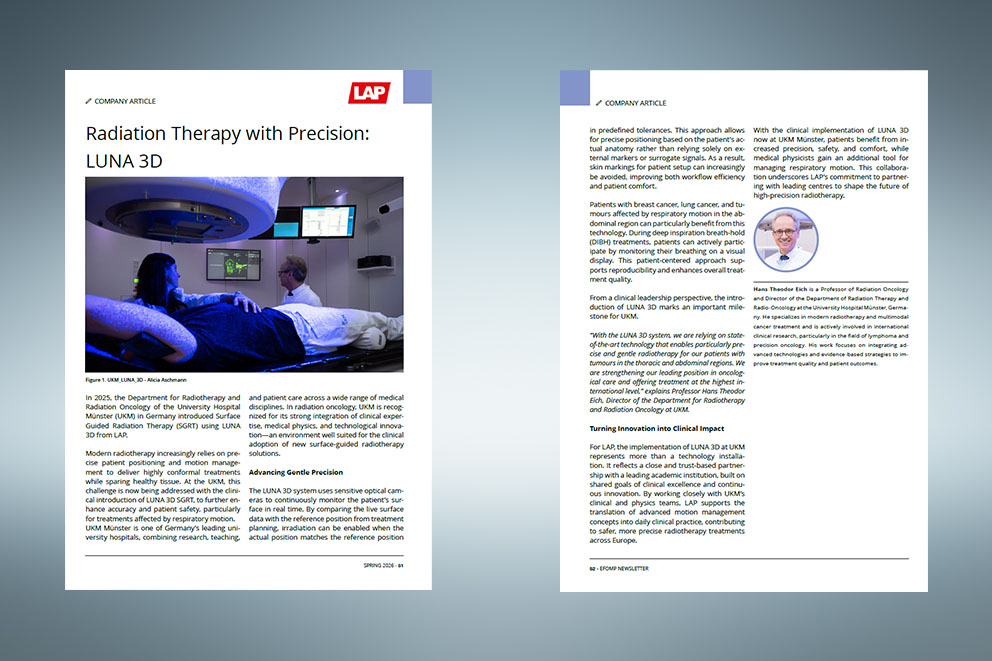
In 2025, the Department for Radiotherapy and Radiation Oncology of the University Hospital Münster (UKM) in Germany introduced Surface Guided Radiation Therapy (SGRT) using LUNA 3D from LAP.
Modern radiotherapy increasingly relies on precise patient positioning and motion management to deliver highly conformal treatments while sparing healthy tissue. At the UKM, this challenge is now being addressed with the clinical introduction of LUNA 3D SGRT, to further enhance accuracy and patient safety, particularly for treatments affected by respiratory motion. UKM Münster is one of Germany’s leading university hospitals, combining research, teaching, and patient care across a wide range of medical disciplines. In radiation oncology, UKM is recognized for its strong integration of clinical expertise, medical physics, and technological innovation—an environment well suited for the clinical adoption of new surface-guided radiotherapy solutions.
Advancing Gentle Precision
The LUNA 3D system uses sensitive optical cameras to continuously monitor the patient’s surface in real time. By comparing the live surface data with the reference position from treatment planning, irradiation can be enabled when the actual position matches the reference position in predefined tolerances. This approach allows for precise positioning based on the patient’s actual anatomy rather than relying solely on external markers or surrogate signals. As a result, skin markings for patient setup can increasingly be avoided, improving both workflow efficiency and patient comfort.
Patients with breast cancer, lung cancer, and tumours affected by respiratory motion in the abdominal region can particularly benefit from this technology. During deep inspiration breath-hold (DIBH) treatments, patients can actively participate by monitoring their breathing on a visual display. This patient-centered approach supports reproducibility and enhances overall treat mentquality.
From a clinical leadership perspective, the introduction of LUNA 3D marks an important milestone for UKM.
“With the LUNA 3D system, we are relying on state-of-the-art technology that enables particularly precise and gentle radiotherapy for our patients with tumours in the thoracic and abdominal regions. We are strengthening our leading position in oncological care and offering treatment at the highest international level,” explains Professor Hans Theodor Eich, Director of the Department for Radiotherapy and Radiation Oncology at UKM.
Turning Innovation into Clinical Impact
For LAP, the implementation of LUNA 3D at UKM represents more than a technology installation. It reflects a close and trust-based partnership with a leading academic institution, built on shared goals of clinical excellence and continuous innovation. By working closely with UKM’s clinical and physics teams, LAP supports the translation of advanced motion management concepts into daily clinical practice, contributing to safer, more precise radiotherapy treatments across Europe.
With the clinical implementation of LUNA 3D now at UKM Münster, patients benefit from in creased precision, safety, and comfort, while medical physicists gain an additional tool for managing respiratory motion. This collaboration underscores LAP’s commitment to partnering with leading centres to shape the future of high-precision radiotherapy.
CV Mr. Hans Theodor Eich
Hans Theodor Eich is a Professor of Radiation Oncology and Director of the Department of Radiation Therapy and Radio-Oncology at the University Hospital Münster, Germany. He specializes in modern radiotherapy and multimodal cancer treatment and is actively involved in international clinical research, particularly in the field of lymphoma and precision oncology. His work focuses on integrating advanced technologies and evidence-based strategies to improve treatment quality and patient outcomes.