
Commissioning of LUNA 3D Surface-Guided Radiation Therapy in full rotating gantry proton therapy system
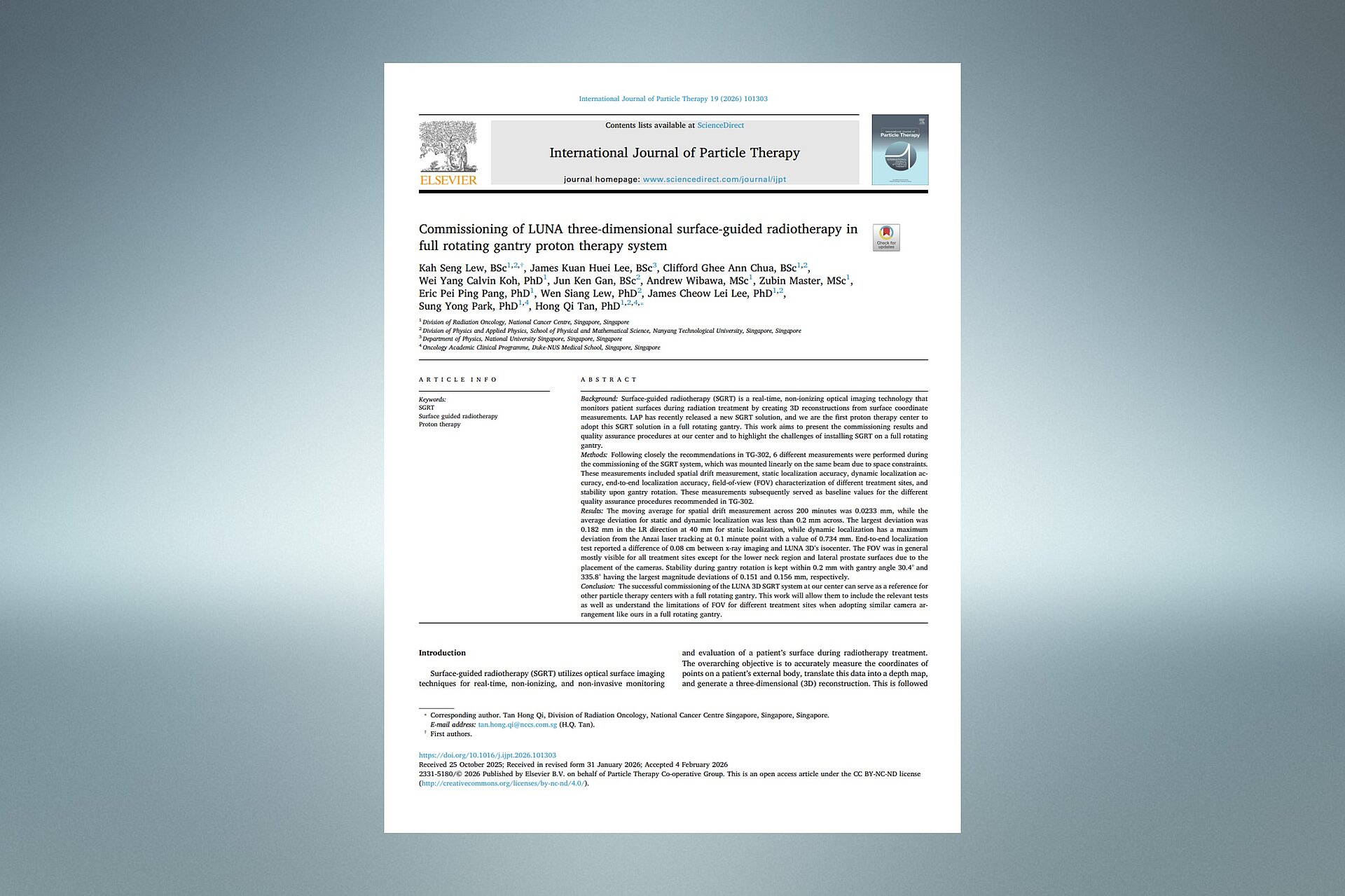
“The successful commissioning of the LUNA 3D SGRT system at our center can serve as a reference for other particle therapy centers with a full rotating gantry.”
Authors
Kah Seng Lew, James Kuan Huei Lee, Clifford Ghee Ann Chua, Calvin Wei Yang Koh, Jun Ken Gan, Andrew Wibawa, Zubin Master, Eric Pei Ping Pang, Wen Siang Lew, James Cheow Lei Lee, Sung Yong Park, Hong Qi Tan
Source
International Journal of Particle Therapy, Volume 19, 2026, https://doi.org/10.1016/j.ijpt.2026.101303.
Abstract
Surface-guided radiotherapy (SGRT) is a real-time, non-ionising optical imaging technology that monitors patient surfaces during radiation treatment by creating 3D reconstructions from surface coordinate measurements. LAP has recently released a new SGRT solution, and we are the first proton therapy centre to adopt this SGRT solution in a full rotating gantry. This work aims to present the commissioning results and quality assurance procedures at our center and to highlight the challenges of installing SGRT on a full rotating gantry.
Methods
Following closely the recommendations in TG-302, six different measurements were performed during the commissioning of the SGRT system, which was mounted linearly on the same beam due to space constraints. These measurements included spatial drift measurement, static localization accuracy, dynamic localization accuracy, end-to-end localization accuracy, field-of-view characterization of different treatment sites, and stability upon gantry rotation. These measurements subsequently served as baseline values for the different quality assurance procedures recommended in TG-302.
Results
The moving average for spatial drift measurement across 200 minutes was 0.0233 mm while the average deviation for static and dynamic localization was less than 0.2 mm across. The largest deviation was 0.182 mm in the LR direction at 40 mm for static localization while dynamic localization has a maximum deviation from the Anzai laser tracking at 0.1 min point with a value of 0.734 mm. End-to-end localization test reported a difference of 0.08 cm between x-ray imaging and LUNA 3D’s isocenter. The field-of-view was in general mostly visible for all treatment sites except for the lower neck region and lateral prostate surfaces due to the placement of the cameras. Stability during gantry rotation is kept within 0.2 mm with gantry angle 30.4° and 335.8° having the largest magnitude deviation of 0.151 mm and 0.156 mm respectively.
Conclusion
The successful commissioning of the LUNA 3D SGRT system at our center can serve as a reference for other particle therapy centers with a full rotating gantry. This work will allow them to include the relevant tests as well as understand the limitations of field-of-view for different treatment sites when adopting similar camera arrangement like ours in a full rotating gantry.
The non-clinical study involved only the commissioning of the SGRT system. The system was not used for radiation therapy in a clinical context.