The New More in SGRT
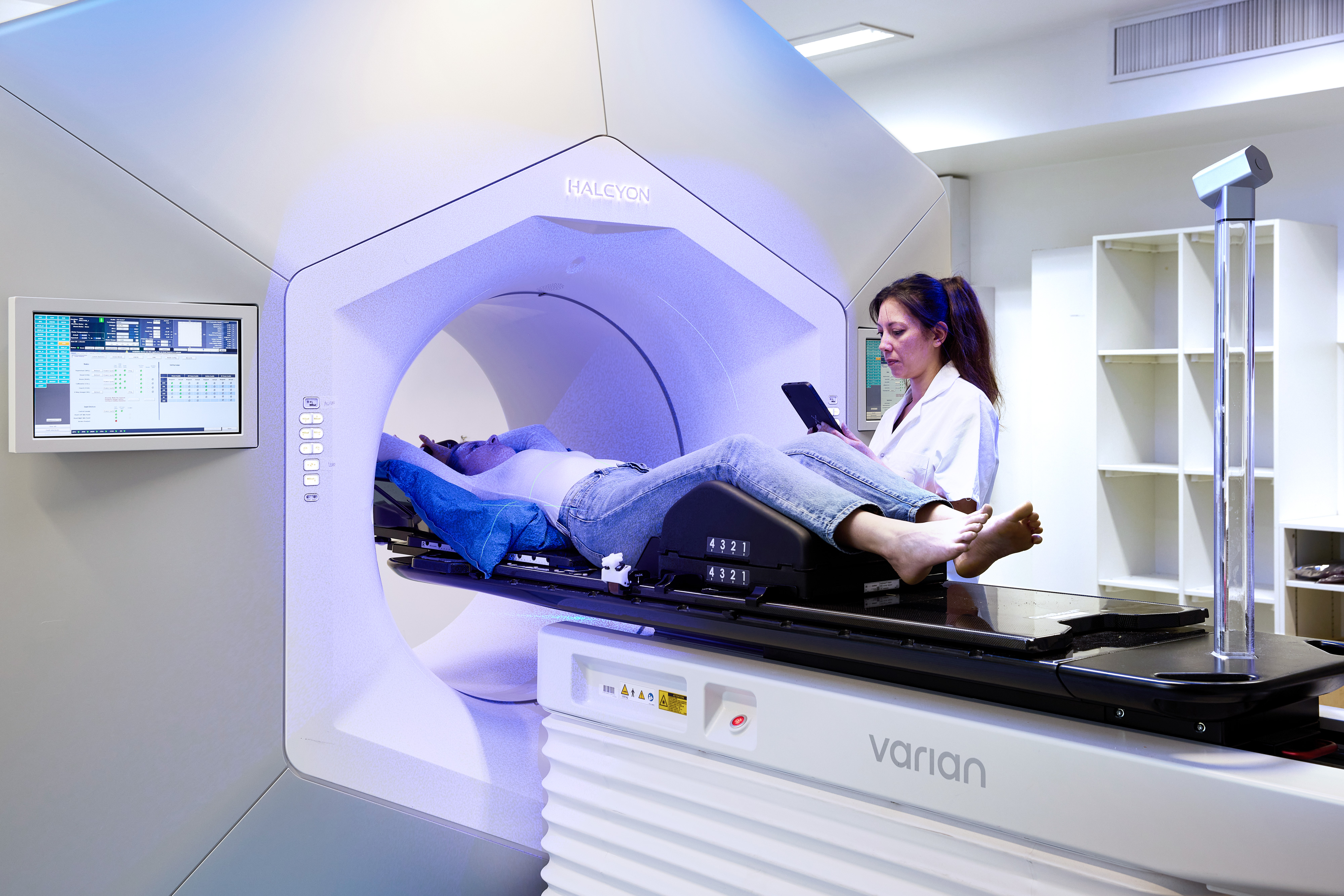
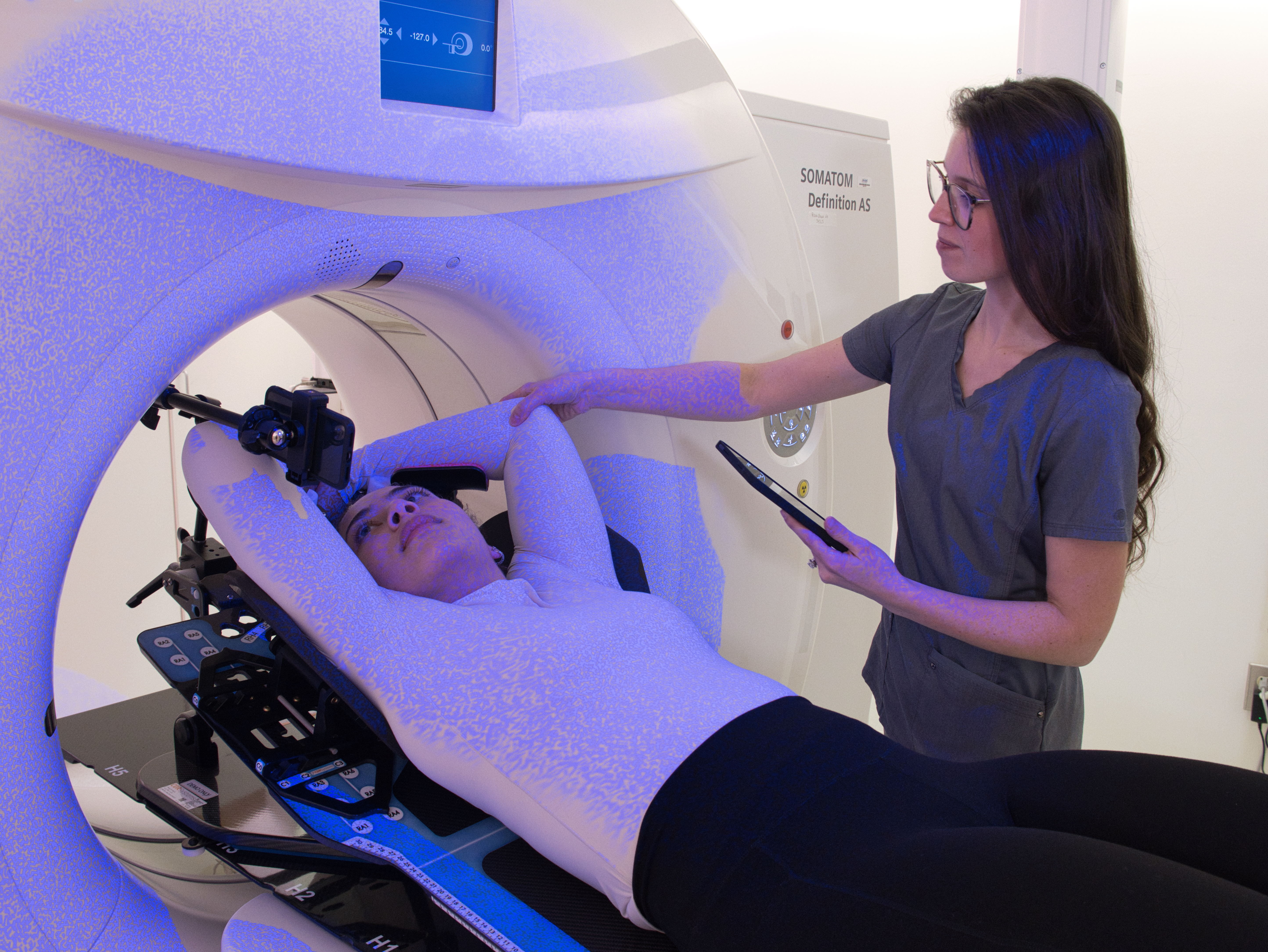
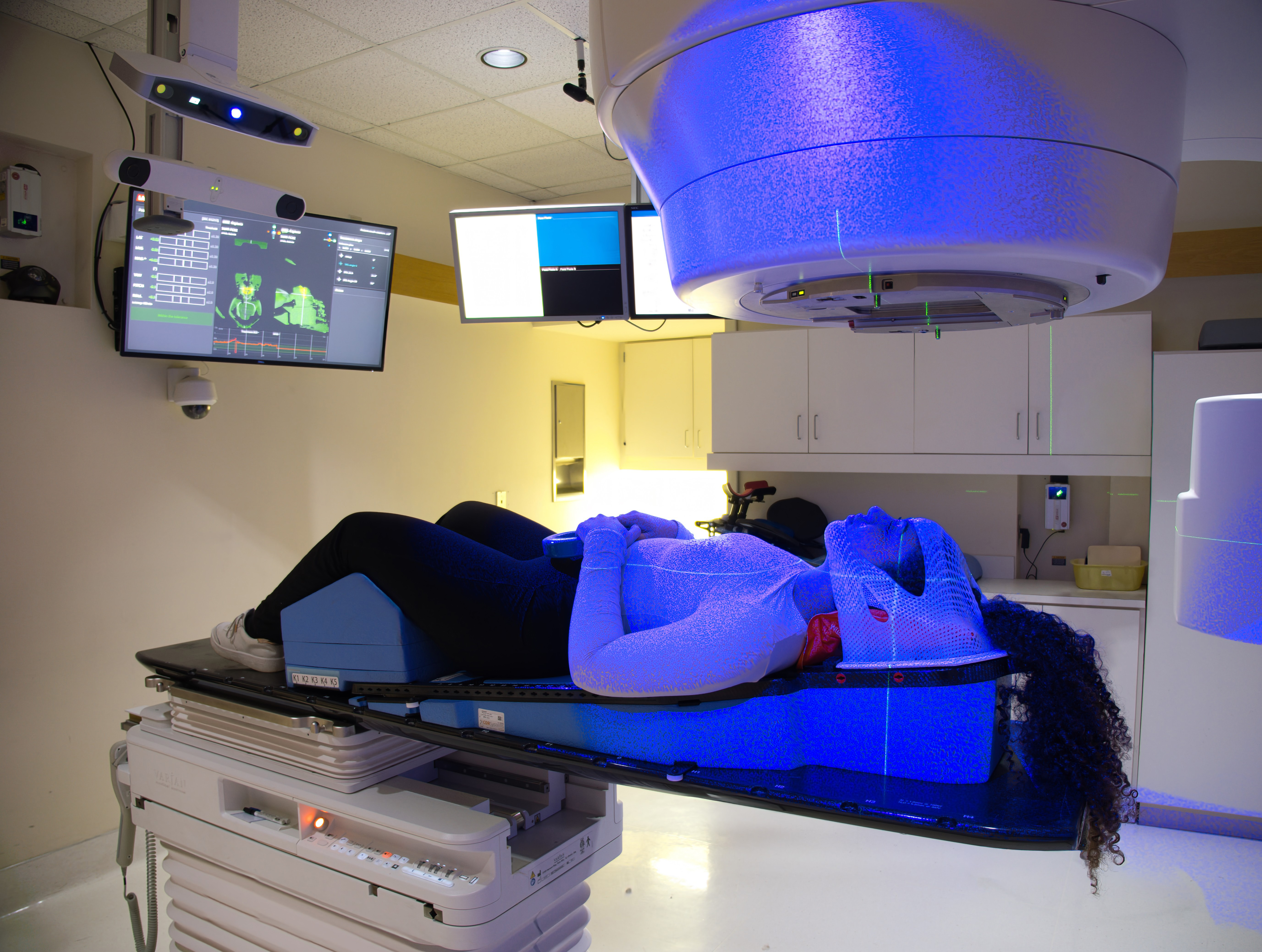
LUNA 3D brings LAP’s decades of experience in laser-based patient positioning to Surface Guided Radiation Therapy (SGRT). Its virtual laser tool translates the familiar room laser concept into intuitive software guidance. High-resolution stereoscopic cameras and blue speckle light projection enable precise, markerless setup and continuously monitor the patient’s surface.
From CT simulation through treatment delivery, LUNA 3D connects the workflow in one intuitive, browser-based system. A large field of view supports ergonomic patient setup, while visual breath-hold guidance and data exchange with compatible imaging and treatment systems help streamline imaging and treatment workflows.










LUNA 3D system components
General
What is the LUNA 3D system all about?
The LUNA 3D system from LAP is a surface-guided radiation therapy (SGRT) system designed for reproducible patient positioning and monitoring during radiotherapy treatments.
What are the ambient operating conditions for the LUNA 3D system?
The LUNA 3D system should operate in temperatures between 15-30°C with relative humidity of 25-80% (non-condensing) and at altitudes up to 2000 meters.
Configuration
In which configurations can I install a LUNA 3D system?
The LUNA 3D system is available in three configurations: 1-camera-pod system for CTs, 3-camera-pod system for C-arm LINACs, and 4-camera-pod system for bore-type LINACs.
Can I use LUNA 3D at my LINAC without a LUNA 3D system at my CT?
Yes. The LUNA 3D at the CT is optional. The LUNA 3D system installed at the CT supports breath-hold coaching and monitoring duirng the CT scan. At the LINAC, imported DICOM datasets in free-breathing and breath-hold are used for patient setup and monitoring.
Installation
What are the prerequisites for ceiling installation of the LUNA 3D camera pods?
A solid, non-vibrating ceiling is required, while direct mounting on suspended ceilings is not permitted. Please consult LAP for further assistance and room planning services.
How do I prepare my room for a LUNA 3D installation?
Provide true-to-scale room drawings of the treatment room, ensure suitable ceiling and wall constructions, and preconfigure network and power connections. Please consult LAP for further assistance and room planning services.
What are the main components of the LUNA 3D system?
The main components of LUNA 3D in the LINAC room include camera pods, a setup screen, a setup PC, a tablet, a patient coaching screen and an electrical distribution box. The control room is equipped with a LUNA 3D PC and monitor.
What type of server is required for the LUNA 3D system?
A physical or virtual server with Microsoft Windows Server 2022, at least 4 cores, 16 GB RAM, 400 GB SSD, and a 1 Gbps network connection is required.
How is the LUNA 3D system integrated with my hospital networks?
The LUNA 3D system integrates via a dedicated server and requires configuration of network settings, firewall rules, and user authentication methods.
Service
What should I do if there is an error with the LUNA 3D system?
Refer to the troubleshooting section of the manual for guidance on resolving common issues, or contact LAP technical support for assistance.
Who can I contact in case I need help with LUNA 3D?
The global LAP service network supports you by telephone, remote diagnosis, or personally on site. With technicians in America, Europe, and Asia, we are accessible in every time zone. Our services include commissioning, user training, maintenance, support hotline, parts replacement and repair.
Do you offer service contracts?
LAP offers three different service contracts to fulfil individual customer needs. Depending on the service level, the contracts include services, software and hardware options.
How do I update the software for the LUNA 3D system?
The LUNA 3D system supports software updates via the LAP cloud infrastructure. Ensure the server can connect to the Internet and follow the update management process.
Operation
What is the precision of the LUNA 3D system?
The LUNA 3D multipod system has a precision of less than 0.5 mm for shifting and less than 0.5° for rotation, with a 6-DOF latency registration of less than 250 ms using the 3 pod configuration.
How is the LUNA 3D system calibrated?
The LUNA 3D system undergoes basic camera pod calibration processes and daily QA camera pod verification, ensuring accurate patient positioning and monitoring.
How does the LUNA 3D system import patient data?
Patient data can be imported using the DICOM RT interface of LUNA 3D.
What is the reference when positioning patients with LUNA 3D at the LINAC?
The reference for patient positioning at the LINAC is the DICOM import of the patient surface from CT imaging or the SGRT surface reference acquired by LUNA 3D at the Linac.
What our customers say
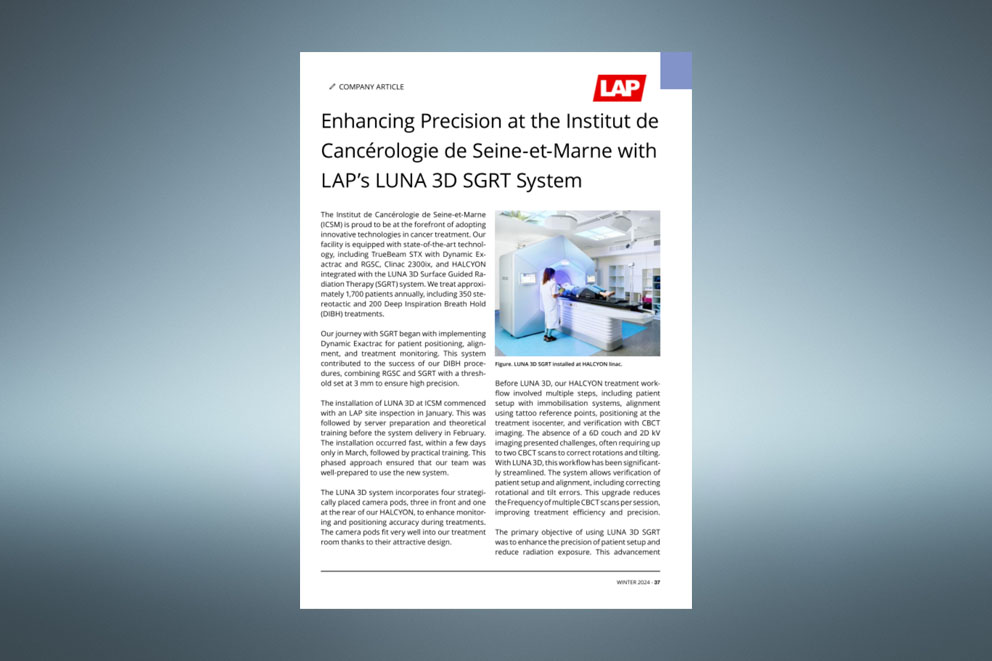
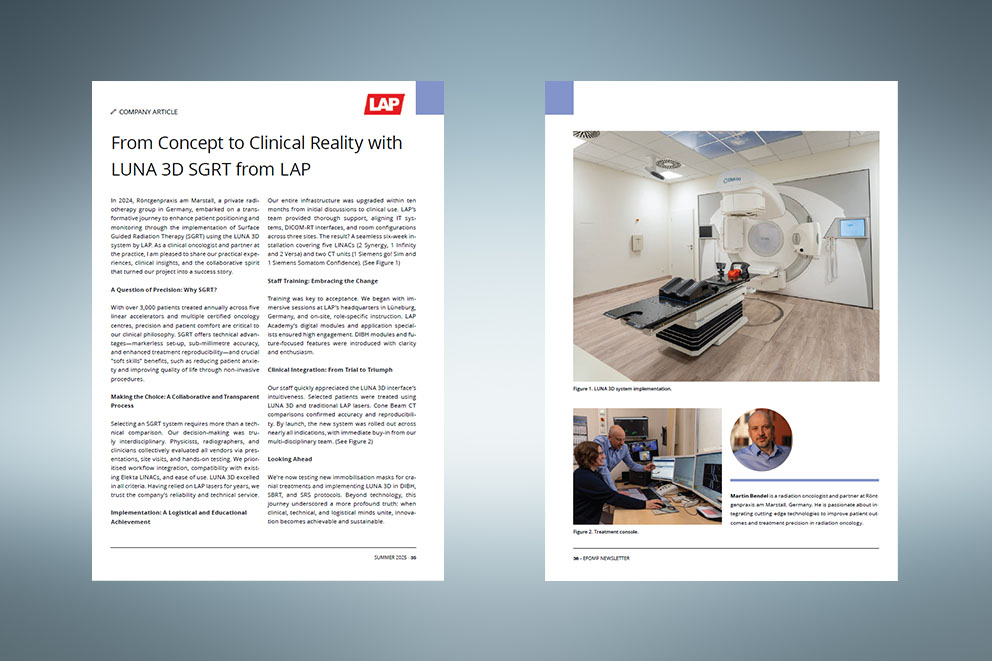
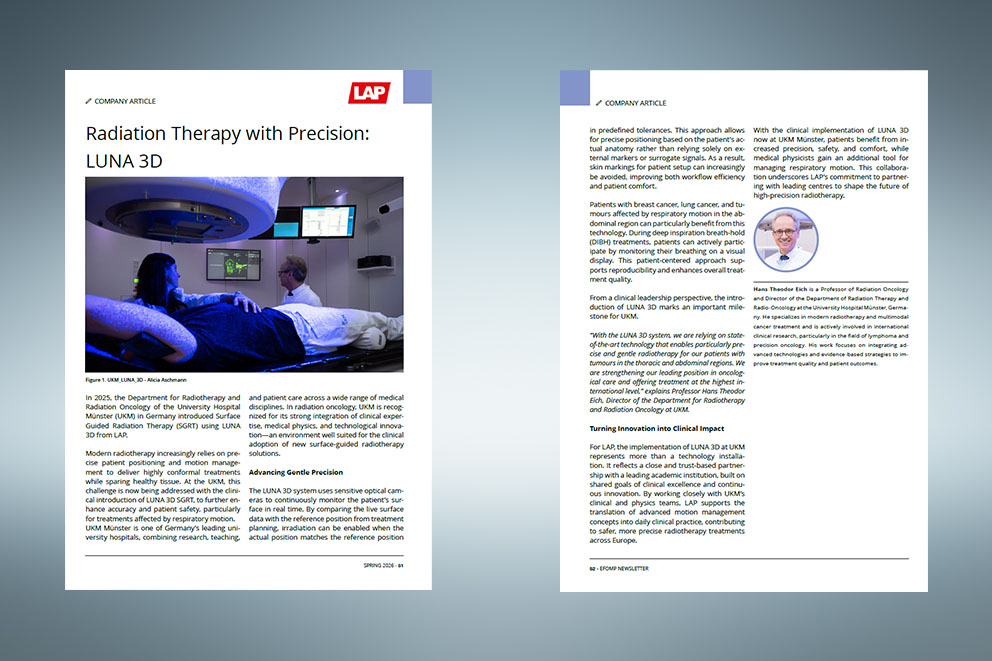
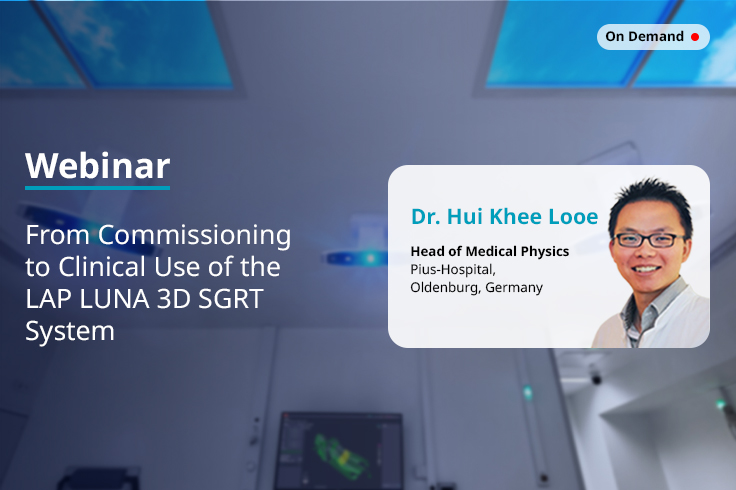
- We particularly like the simple and intuitive user interface and the innovative virtual laser concept.
- In pelvic patients, post-LUNA CBCT shifts have decreased from roughly 1 cm ± 0.5 cm to 0.5 cm ± 0.2 cm. That has significantly reduced the need to re-enter the vault for repositioning or to perform second CBCT verification scans.
- LAP-Laser vs. LUNA 3D showed excellent positioning and reproducibility. Hopefully, we can reduce the number of cone beams in the near future.
- LUNA 3D enables fast, safe, and reproducible patient positioning, very intuitive to use and integrates
seamlessly into the workflow. - The sessions are more comfortable and faster, with fewer constraints during treatment. The time spent under the machine is reduced, which makes the experience more reassuring.
- The throughput of patients is much quicker. That’s the first thing that was extremely noticeable.