
Commissioning and end-to-end validation of a combined surface-guided and triggered kV imaging workflow for breath-hold SBRT on a Varian TrueBeam
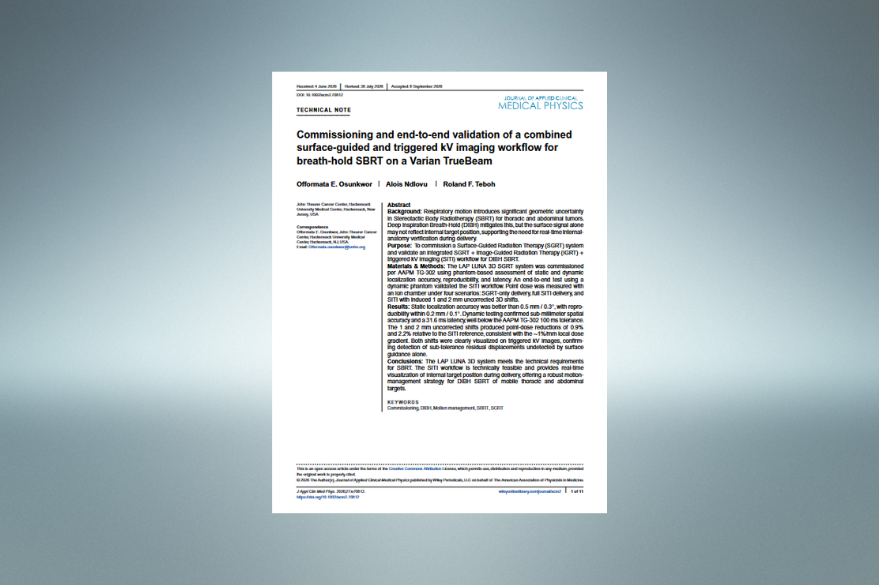
“Commissioning and end-to-end validation of a combined surface-guided and triggered kV imaging workflow for breath-hold SBRT on a Varian TrueBeam”
Authors
Offormata E. Osunkwor, Alois Ndlovu, Roland F. Teboh
Source
https://aapm.onlinelibrary.wiley.com/doi/10.1002/acm2.70812
Background
Respiratory motion introduces significant geometric uncertainty in Stereotactic Body Radiotherapy (SBRT) for thoracic and abdominal tumors. Deep Inspiration Breath-Hold (DIBH) mitigates this, but the surface signal alone may not reflect internal target position, supporting the need for real-time internal-anatomy verification during delivery.
Purpose
To commission a Surface-Guided Radiation Therapy (SGRT) system and validate an integrated SGRT + Image-Guided Radiation Therapy (IGRT) + triggered kV imaging (SITI) workflow for DIBH SBRT.
Methods
The LAP LUNA 3D SGRT system was commissioned per AAPM TG-302 using phantom-based assessment of static and dynamic localization accuracy, reproducibility, and latency. An end-to-end test using a dynamic phantom validated the SITI workflow. Point dose was measured with an ion chamber under four scenarios: SGRT-only delivery, full SITI delivery, and SITI with induced 1 and 2 mm uncorrected 3D shifts.
Results
Static localization accuracy was better than 0.5 mm / 0.3°, with reproducibility within 0.2 mm / 0.1°. Dynamic testing confirmed sub-millimeter spatial accuracy and a 31.6 ms latency, well below the AAPM TG-302 100 ms tolerance. The 1 and 2 mm uncorrected shifts produced point-dose reductions of 0.9% and 2.2% relative to the SITI reference, consistent with the ∼1%/mm local dose gradient. Both shifts were clearly visualized on triggered kV images, confirming detection of sub-tolerance residual displacements undetected by surface guidance alone.
Conclusion
The LAP LUNA 3D system meets the technical requirements for SBRT. The SITI workflow is technically feasible and provides real-time visualization of internal target position during delivery, offering a robust motion-management strategy for DIBH SBRT of mobile thoracic and abdominal targets.